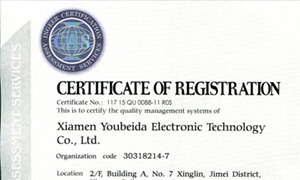




Ubeida got the ISO9001 certificated
In 2015, we got the ISO9001:2008 certificated.We have strict quality management system, which will help us improve the product quality and perfect the production management.
1.MEMS Microphone (Silicon Microphone)
Ever wondered how your headphones’ tiny microphone picks up your voice? That’s probably a MEMS microphone—short for Micro-Electro-Mechanical System. Think of it as a "miniature sound detector" built on a silicon chip. At its core are two ultra-thin parts: a vibrating diaphragm and a fixed backplate, with a tiny air gap between them. Together, they form a tiny capacitor (a device that stores electric charge). When sound waves hit the diaphragm, it wiggles gently with the sound pressure. This wiggling changes the size of the air gap, which in turn alters the capacitor’s ability to hold charge. The microphone’s built-in circuit catches this change and turns it into an electrical signal that your device can understand.
In terms of structure, MEMS microphones are true "mini marvels." Everything is squeezed onto a silicon chip smaller than a grain of rice, and they’re usually packaged with a special chip called an ASIC that fine-tunes the signal. Thanks to semiconductor manufacturing—similar to how computer chips are made—they can be produced in huge quantities at low cost. That’s why they’re everywhere: in smartphones, wireless earbuds, smartwatches, and any device where space is at a premium.
2.Electret Microphone
The electret microphone is a classic "middleweight" in the microphone world—bigger than a MEMS mic but smaller than a stage microphone. It’s also a type of capacitive microphone, but with a clever twist: its diaphragm or backplate is coated with an electret material that holds a permanent electric charge, like a tiny, never-dying battery for sound detection. When sound waves make the diaphragm vibrate, the distance between the diaphragm and backplate changes, which tweaks the capacitor’s charge and creates a super weak electrical signal.
But here’s the catch: that weak signal needs a boost to be useful. So electret microphones come with a tiny built-in amplifier (called an FET) to make the signal strong enough for devices to process. This amplifier needs a little external power—usually from a small resistor in the device’s circuit—to work. Structurally, it’s made up of the electret diaphragm, a metal backplate, an insulating spacer, the FET amplifier, and a metal case. You’ll find these mics in things like desktop computers, intercoms, and cheap audio recorders—they’re affordable and sensitive enough for everyday use.
3.Dynamic Microphone
If you’ve ever seen a singer holding a big, sturdy microphone on stage, that’s almost certainly a dynamic microphone. Unlike the two types above, it doesn’t rely on capacitors or tiny chips—instead, it uses good old-fashioned electromagnetic induction, similar to how a small generator works. Inside the mic, there’s a lightweight diaphragm connected to a tiny coil of wire. This coil sits inside a strong magnetic field created by a permanent magnet.
When sound waves hit the diaphragm, it moves back and forth, pulling the coil along with it. As the coil moves through the magnetic field, it "cuts" the magnetic lines of force, which generates an electrical signal—no batteries or external power needed! The signal’s rhythm and strength match the original sound waves perfectly.
Structurally, dynamic mics are built to last. They have a tough metal case, a durable diaphragm, a sturdy coil, and a powerful magnet—making them bulkier than capacitive mics, but also super rugged. They can handle loud sounds without breaking, which is why they’re the go-to choice for concerts, live broadcasts, and recording studios. No power cord, no fragile chips—just reliable sound capture that stands up to rough use.